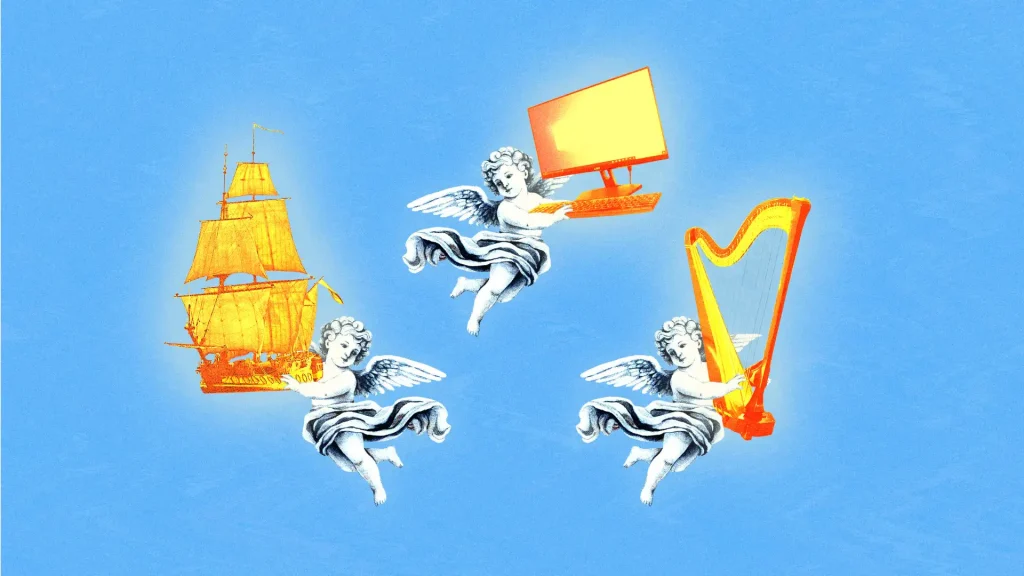
“Will there be harps in heaven?” I often ask my senior computer science students. Most respond with certainty, imagining celestial music filling eternity. But when I follow with, “Will there be computers in heaven? What about AI?” hesitation arises. Many assume that technology is confined to earthly life, while music, poetry, or other cultural expressions seem more enduring. Yet both harps and computers are products of human creativity—manifestations of the latent potential within God’s creation. This raises an intriguing question: if God’s plan redeems all things, could AI and computers also find a place in the renewed cosmos?
From the earliest chapters of Genesis, humans are depicted as exploring creation’s possibilities. Jubal mastered music with the harp and flute, while Tubal-Cain forged tools from bronze and iron—proto-engineers shaping the material world. Over time, this potential expands to encompass all forms of cultural and technological expression: poetry, paintings, baked goods, musical instruments, airplanes, and, eventually, artificial intelligence. AI, like all human creations, arises from patterns embedded in the natural world: the symmetry of flowers, the algorithms in DNA, the mathematics underlying traffic, or the rhythmic structures of music. Computers and AI are tools that allow us to process and interact with these patterns in ways previously unimaginable, amplifying human creativity and problem-solving capacity.
However, human sinfulness complicates the use of these tools. Just as creation groans under the weight of the Fall, technology can be misapplied through bias, manipulation, or the pursuit of self-glorifying ends. AI can amplify misinformation, entrench inequality, or foster idolatry of data and machines. Some futurists envision AI as humanity’s savior, capable of curing disease, facilitating interstellar travel, or creating digital immortality. Others propose “mind-uploading” and virtual paradises, imagining that merging with AI equates to eternal life. Yet these visions mistake tools for salvation. They reduce humans to data points, overlooking the biblical affirmation that humans are whole beings of body, mind, soul, and spirit, fearfully and wonderfully made in God’s image.
The biblical narrative does not end with despair or human ingenuity alone. Redemption through Christ promises the reconciliation of all things, restoring creation and guiding humanity to participate in God’s renewing work. Ethical and thoughtful use of AI—enhancing agriculture, medicine, scientific discovery, or fostering creativity—can exemplify stewardship and align with divine purposes. AI can assist in analyzing medical images, predicting environmental patterns, translating languages, or even inspiring new artistic expressions. Yet these tools remain instruments; they do not replace God’s ultimate authority or the reality of resurrection. The new creation is not a digital simulation but a tangible, embodied renewal: a resurrection of imperishable bodies in a sinless, glorified world.
Scripture hints at continuity between present cultural activity and the life to come. Isaiah depicts animals, precious metals, and ships brought into the service of God’s glory. Revelation envisions nations offering their splendor to the New Jerusalem. If such mundane artifacts as trading ships are included, why exclude modern inventions like computers or AI? Perhaps, in the new heavens and earth, technology will serve joyfully, supporting human creativity, learning, and exploration while reflecting God’s wisdom and glory. This suggests a vision of a future where tools of commerce, communication, and computation are redeemed for divine purposes rather than exploited for self-interest.
Imagining AI in the new creation is both speculative and inspiring. Perhaps sin-free computers will help us uncover the beauty and complexity of creation, analyze the intricate patterns in music and mathematics, or assist in community problem-solving. We might even envision AI participating in collaborative creativity alongside humans—designing gardens, cities, or educational programs—all dedicated to God’s glory. In this vision, technology is not the path to salvation but a medium through which human creativity and stewardship reflect divine intentions.
Ultimately, AI will neither transport us to heaven nor constitute heaven itself. Yet it may accompany us there, transformed and redeemed, echoing the patterns of God’s creation without the distortions of sin. Harps may resound alongside computers, and AI, guided by divine purposes, may participate in the delight and work of the renewed world. Human creativity—now expressed in digital tools as well as music, art, and craft—may endure, not as ends in themselves but as instruments glorifying God in eternity.
The vision is both sobering and hopeful: technology, when redeemed and rightly oriented, may persist in God’s new creation, offering new ways to marvel at the beauty of patterns, to explore creativity, and to serve others. AI, then, could indeed be there—not as a substitute for human life or divine presence, but as part of the rich tapestry of God’s eternal renewal. The question shifts from whether AI will exist in heaven to how human ingenuity, guided by wisdom and love, participates in God’s work of restoring all things, blending creativity, technology, and faith in a redeemed universe.